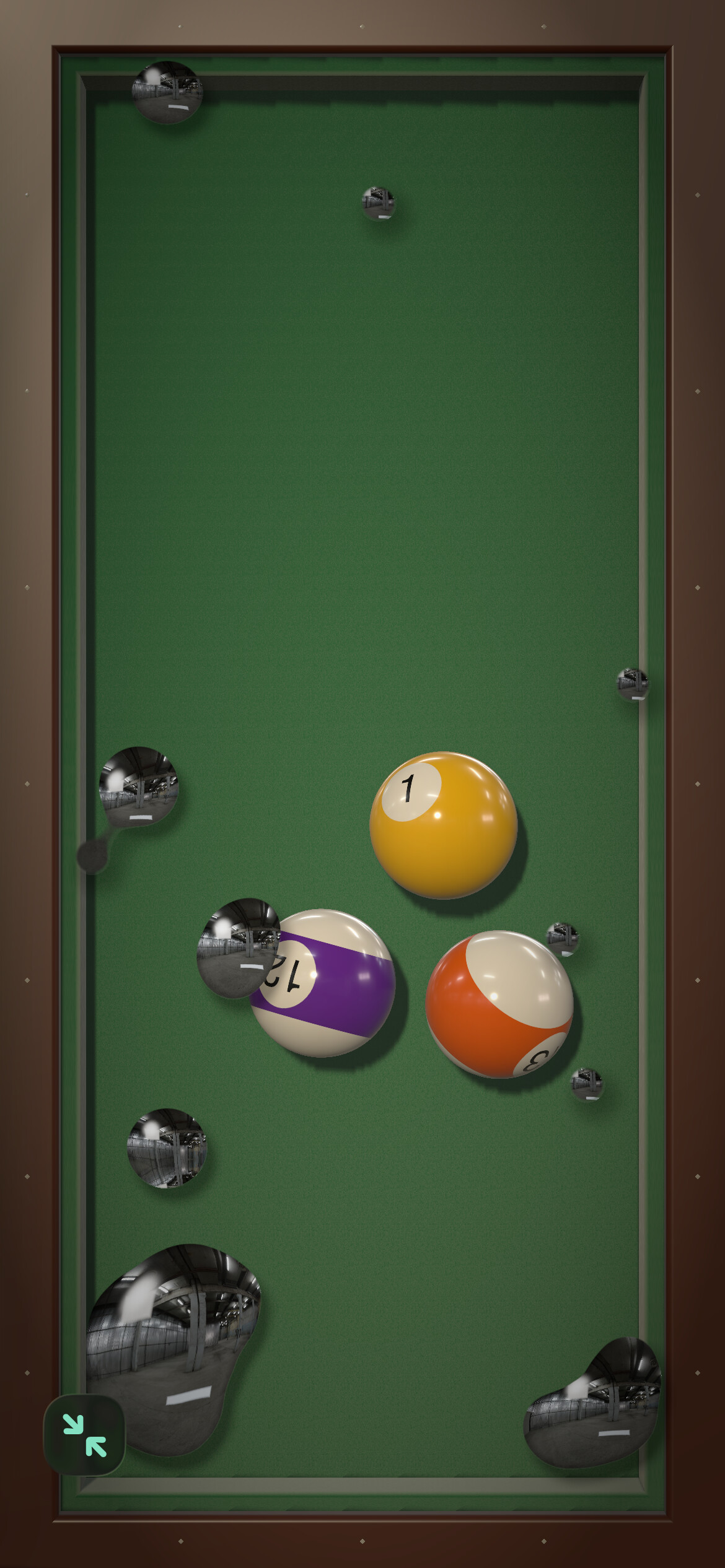
I had Claude fuse the new Mercury example project and the Pool Balls project.
If balls roll into each other fast enough, one of them will explode into mercury and roll around the table a little before drawing itself back together and becoming a pool ball again.
Just add this code as the last tab in the pool balls project:
--# Main
-- Mercury Pool
-- Pool balls on a felt table. Hit one hard enough and it may burst into liquid
-- mercury, which slithers around under the tilt of each half, then pulls
-- itself back into the ball. Drag a ball to place it, or flick it into others.
function setup()
  viewer.mode = FULLSCREEN
  pool = Table()
  local s = RADIUS * 2.15
  balls = {
    Ball(pool, 1,  color(250, 196, 30), vec2(0, 0)),
    Ball(pool, 2,  color(30, 90, 210),  vec2(-s, -s)),
    Ball(pool, 3,  color(215, 45, 40),  vec2(s, -s)),
    Ball(pool, 12, color(115, 50, 175), vec2(-s, s)),
    Ball(pool, 13, color(240, 105, 25), vec2(s, s)),
  }
  liquid = Liquid()
  metal = Metal()
  lampFalloff = radialShade(128, function(d) return 0.72 * d ^ 1.7 end)
end
-- true when the fold runs up the screen, false across it, nil without a hinge
function foldVertical()
  local halves = hinge.halves
  if #halves < 2 then return nil end
  return halves[1].bounds.width < WIDTH
end
function updateBalls(dt)
  for _, ball in ipairs(balls) do ball:step(dt) end
  for iter = 1, 3 do
    for i = 1, #balls do
      for j = i + 1, #balls do balls[i]:collide(balls[j]) end
      balls[i]:bounce()
    end
  end
  for _, ball in ipairs(balls) do ball:place() end
end
function draw()
  local fold = foldVertical()
  if pool.width ~= WIDTH or pool.height ~= HEIGHT or pool.foldVertical ~= fold then
    pool:build(fold)
    liquid:clear()
    for _, ball in ipairs(balls) do ball:reset() end
  end
  local dt = math.min(DeltaTime, 1 / 30)
  updateBalls(dt)
  liquid:update(dt, hinge.halves, pool)
  local mercury = #liquid.particles > 0
  if mercury then metal:splat(liquid.particles) end
  pool.scene:draw()
  if mercury then metal:draw() end
  sprite(lampFalloff, WIDTH / 2, HEIGHT / 2, WIDTH * 1.15, HEIGHT * 1.15)
end
function touched(touch)
  local p = vec2(touch.x, touch.y)
  if touch.state == BEGAN then
    local closest, bestDist = nil, RADIUS * 2
    for _, ball in ipairs(balls) do
      local d = p:distance(ball.pos)
      if not ball.held and not ball.molten and d < bestDist then
        closest, bestDist = ball, d
      end
    end
    if closest then
      closest.held = true
      closest.touchId = touch.id
      closest.vel = vec2()
      closest:dragTo(touch.x, touch.y)
    end
  else
    for _, ball in ipairs(balls) do
      if ball.held and ball.touchId == touch.id then
        if touch.state == ENDED or touch.state == CANCELLED then
          ball.held = false
          ball.touchId = nil
        else
          ball:dragTo(touch.x, touch.y)
        end
      end
    end
  end
end

--# Ball
-- Ball
-- Rolls in screen points under each half's gravity; drawn as a 3D pool ball
-- that turns as it rolls. A hard hit can melt the struck ball into mercury.
RADIUS = 39           -- points
GRAVITY = 2400        -- points / s^2 at 1g
ROLLING = 5 / 7       -- a rolling solid sphere feels 5/7 of the slope's pull
ROLLING_DRAG = 0.35   -- per second
CUSHION_BOUNCE = 0.7
BALL_BOUNCE = 0.92
MELT_SPEED = 450      -- closing speed (points/s) a hit needs to risk a melt
MELT_CHANCE = 0.25    -- chance that such a hit does melt the struck ball
Ball = class()
function Ball:init(tbl, number, ballColor, offset)
  self.table = tbl
  self.offset = offset or vec2()
  self.pos = vec2(WIDTH / 2, HEIGHT / 2) + self.offset
  self.vel = vec2()
  self.molten = false
  local finish = material.lit()
  finish.map = poolBallTexture(number, ballColor)
  finish.roughness = 0.12
  finish.reflectance = 0.6
  finish.enableClearCoat = true
  finish.clearCoat = vec2(1, 0.03)
  local s = tbl.scene
  self.entity = s:entity("ball " .. number)
  local sphere = mesh.sphere(RADIUS / SCALE, 64, 32)
  sphere.material = finish
  self.entity:add(sphere)
  self.entity.rotation = quat.eulerAngles(number * 37, number * 73, number * 19)
  -- Darkens the cloth right where the ball touches it
  local contact = material.unlit()
  contact.map = radialShade(64, function(d) return (1 - d) ^ 2.5 * 0.85 end)
  contact.blend = 2 -- transparent
  self.contact = s:entity("contact shadow " .. number)
  local blob = mesh.plane(vec2(RADIUS * 1.3 / SCALE))
  blob.material = contact
  self.contact:add(blob)
  self.contact.rotation = quat.eulerAngles(-90, 0, 0)
end
-- A molten ball is shrunk to nothing, so it neither draws nor casts a shadow
function Ball:show(on)
  local k = on and 1 or 0.001
  self.entity.scale = vec3(k, k, k)
  self.contact.scale = vec3(k, k, k)
end
function Ball:reset()
  self.pos = vec2(WIDTH / 2, HEIGHT / 2) + self.offset
  self.vel = vec2()
  self.lastCentre = nil
  self.molten = false
  self:show(true)
end
function Ball:melt()
  self.molten = true
  self:show(false)
  liquid:melt(self, self.vel)
end
-- The mercury has gathered again: the ball reappears where it pooled
function Ball:reform(x, y, vel)
  self.pos = vec2(x, y)
  self.vel = vel
  self.molten = false
  self.lastCentre = nil
  self:show(true)
end
function Ball:step(dt)
  if self.held or self.molten then return end
  local half = hinge.halfAt(self.pos)
  if half then
    local g = half.gravity
    self.vel = self.vel + vec2(g.x, g.y) * GRAVITY * ROLLING * dt
  end
  self.vel = self.vel * (1 - ROLLING_DRAG * dt)
  self.pos = self.pos + self.vel * dt
  self:bounce()
end
function Ball:bounce()
  if self.molten then return end
  local x0, y0, x1, y1 = self.table:playArea()
  local r = RADIUS
  if self.pos.x < x0 + r then self.pos.x = x0 + r; self.vel.x = math.abs(self.vel.x) * CUSHION_BOUNCE end
  if self.pos.x > x1 - r then self.pos.x = x1 - r; self.vel.x = -math.abs(self.vel.x) * CUSHION_BOUNCE end
  if self.pos.y < y0 + r then self.pos.y = y0 + r; self.vel.y = math.abs(self.vel.y) * CUSHION_BOUNCE end
  if self.pos.y > y1 - r then self.pos.y = y1 - r; self.vel.y = -math.abs(self.vel.y) * CUSHION_BOUNCE end
end
function Ball:collide(other)
  if self.molten or other.molten then return end
  local delta = other.pos - self.pos
  local d = delta:len()
  local minDist = RADIUS * 2
  if d <= 0.0001 or d >= minDist then return end
  local n = delta / d
  local overlap = minDist - d
  if self.held and not other.held then
    other.pos = other.pos + n * overlap
  elseif other.held and not self.held then
    self.pos = self.pos - n * overlap
  else
    self.pos = self.pos - n * (overlap * 0.5)
    other.pos = other.pos + n * (overlap * 0.5)
  end
  local vn = (other.vel - self.vel):dot(n)
  local sa, sb = self.vel:len(), other.vel:len()
  if vn < 0 then
    if self.held and not other.held then
      other.vel = other.vel - n * (vn * (1 + BALL_BOUNCE))
    elseif other.held and not self.held then
      self.vel = self.vel + n * (vn * (1 + BALL_BOUNCE))
    else
      local impulse = n * (vn * 0.5 * (1 + BALL_BOUNCE))
      self.vel = self.vel + impulse
      other.vel = other.vel - impulse
    end
    -- the slower ball is the one that got hit
    if -vn > MELT_SPEED and math.random() < MELT_CHANCE then
      local victim = sa <= sb and self or other
      if victim.held then victim = (victim == self) and other or self end
      if not victim.held and liquid:canMelt() then victim:melt() end
    end
  end
end
-- Moves the 3D ball to match, pulled in slightly so perspective puts it under
-- the same screen point, and rolls it without slipping
function Ball:place()
  if self.molten then return end
  local r = RADIUS / SCALE
  local d = self.table:cameraDistance()
  local onBed = self.table:toWorld(self.pos)
  local centre = vec3(onBed.x * (d - r) / d, onBed.y * (d - r) / d, -r)
  local moved = centre - (self.lastCentre or centre)
  self.lastCentre = centre
  local distance = math.sqrt(moved.x * moved.x + moved.y * moved.y)
  if distance > 0 then
    local axis = vec3(moved.y, -moved.x, 0) / distance
    local spin = quat.angleAxis(math.deg(distance / r), axis)
    self.entity.rotation = spin * self.entity.rotation
  end
  self.entity.position = centre
  self.contact.position = vec3(onBed.x, onBed.y, -0.002)
end
function Ball:dragTo(x, y)
  local x0, y0, x1, y1 = self.table:playArea()
  local target = vec2(
  math.clamp(x, x0 + RADIUS, x1 - RADIUS),
  math.clamp(y, y0 + RADIUS, y1 - RADIUS)
  )
  -- Smoothed so a flick carries its speed when released
  self.vel = self.vel * 0.5 + (target - self.pos) / math.max(DeltaTime, 1 / 120) * 0.5
  self.pos = target
end

--# Liquid
-- Liquid
-- Position-based mercury. Neighbours closer than SPACING push apart; a little
-- further out they pull together, which holds droplets whole. Each melted ball
-- is a blob of MELT_PARTS particles, each with a slot in a ball-sized disc.
-- After a delay the blob pulls its particles into those slots, and once they
-- sit there the ball comes back.
SPACING = 15          -- rest distance between particles, in points
COHESION_RANGE = 1.6  -- pull reaches out to this many spacings
MERC_GRAVITY = 1700   -- points / s^2 at 1g
SUBSTEPS = 2
ITERATIONS = 2
MELT_PARTS = 25       -- about a ball's worth of mercury at this spacing
MAX_MOLTEN = 2        -- balls that may be liquid at once
REFORM_DELAY = 1.6    -- seconds of free slithering before gathering starts
REFORM_RAMP = 1.5     -- seconds for the gathering pull to reach full strength
PULL = 10             -- gathering strength
SLOTS = {}
do
  local mx, my = 0, 0
  for i = 1, MELT_PARTS do
    local r = SPACING * 0.52 * math.sqrt(i)
    local a = i * 2.39996
    SLOTS[i] = {r * math.cos(a), r * math.sin(a)}
    mx, my = mx + SLOTS[i][1], my + SLOTS[i][2]
  end
  for i = 1, MELT_PARTS do
    SLOTS[i][1], SLOTS[i][2] = SLOTS[i][1] - mx / MELT_PARTS, SLOTS[i][2] - my / MELT_PARTS
  end
end
Liquid = class()
function Liquid:init()
  self.particles = {}
  self.blobs = {}
  self.play = {0, 0, WIDTH, HEIGHT}
end
function Liquid:clear()
  self.particles, self.blobs = {}, {}
end
function Liquid:canMelt()
  return #self.blobs < MAX_MOLTEN
end
-- Bursts a ball into mercury: out from its middle, plus a share of its motion
function Liquid:melt(ball, vel)
  local blob = {ball = ball, parts = {}, age = 0}
  local k = 1 / (60 * SUBSTEPS)
  for i = 1, MELT_PARTS do
    local ox, oy = SLOTS[i][1], SLOTS[i][2]
    local r = math.max(math.sqrt(ox * ox + oy * oy), 1)
    local out = (0.4 + r / RADIUS) * 260 * k
    local x, y = ball.pos.x + ox, ball.pos.y + oy
    local vx, vy = ox / r * out + vel.x * 0.6 * k, oy / r * out + vel.y * 0.6 * k
    local p = {x = x, y = y, px = x - vx, py = y - vy, loose = 0.5, ox = ox, oy = oy, ramp = 0, blob = blob}
    blob.parts[i] = p
    self.particles[#self.particles + 1] = p
  end
  self.blobs[#self.blobs + 1] = blob
end
local function gravityAt(halves, x, y)
  for _, half in ipairs(halves) do
    local b = half.bounds
    if x >= b.x and x <= b.x + b.width and y >= b.y and y <= b.y + b.height then
      return half.gravity
    end
  end
  return halves[1].gravity
end
function Liquid:update(dt, halves, tbl)
  if #self.particles == 0 then return end
  self.play = {tbl:playArea()}
  local h = dt / SUBSTEPS
  for s = 1, SUBSTEPS do
    self:integrate(h, halves)
    for i = 1, ITERATIONS do self:relax() end
    self:pull(h)
    self:confine()
  end
  for _, p in ipairs(self.particles) do p.loose = math.max(0, p.loose - dt) end
  for i = #self.blobs, 1, -1 do self:age(self.blobs[i], dt) end
end
function Liquid:integrate(h, halves)
  for _, p in ipairs(self.particles) do
    local g = gravityAt(halves, p.x, p.y)
    local damping = 0.996 - 0.04 * p.ramp
    local vx, vy = (p.x - p.px) * damping, (p.y - p.py) * damping
    p.px, p.py = p.x, p.y
    p.x = p.x + vx + g.x * MERC_GRAVITY * h * h
    p.y = p.y + vy + g.y * MERC_GRAVITY * h * h
  end
end
-- Neighbours within reach of each other, found through a grid of reach-sized cells
function Liquid:neighbours()
  local reach = SPACING * COHESION_RANGE
  local cells = {}
  for i, p in ipairs(self.particles) do
    local key = math.floor(p.x / reach) * 4096 + math.floor(p.y / reach)
    local cell = cells[key]
    if not cell then cell = {}; cells[key] = cell end
    cell[#cell + 1] = i
  end
  local found = {}
  local reach2 = reach * reach
  for i, p in ipairs(self.particles) do
    local cx, cy = math.floor(p.x / reach), math.floor(p.y / reach)
    for ox = -1, 1 do
      for oy = -1, 1 do
        local cell = cells[(cx + ox) * 4096 + cy + oy]
        if cell then
          for _, j in ipairs(cell) do
            if j > i then
              local q = self.particles[j]
              local dx, dy = q.x - p.x, q.y - p.y
              if dx * dx + dy * dy < reach2 then found[#found + 1] = {p, q} end
            end
          end
        end
      end
    end
  end
  return found
end
function Liquid:relax()
  local reach = SPACING * COHESION_RANGE
  for _, pair in ipairs(self:neighbours()) do
    local p, q = pair[1], pair[2]
    local dx, dy = q.x - p.x, q.y - p.y
    local d = math.sqrt(dx * dx + dy * dy)
    if d > 0.0001 and d < reach then
      local move = 0
      if d < SPACING then
        move = (SPACING - d) * 0.25
      elseif p.loose == 0 and q.loose == 0 then
        local t = (d - SPACING) / (reach - SPACING)
        move = -(d - SPACING) * 0.12 * (1 - t)
      end
      local mx, my = dx / d * move, dy / d * move
      p.x, p.y = p.x - mx, p.y - my
      q.x, q.y = q.x + mx, q.y + my
    end
  end
end
-- Where a blob wants its disc: its own middle, kept far enough from the rails
function Liquid:target(b)
  local cx, cy = 0, 0
  for _, p in ipairs(b.parts) do cx, cy = cx + p.x, cy + p.y end
  cx, cy = cx / #b.parts, cy / #b.parts
  local x0, y0, x1, y1 = self.play[1], self.play[2], self.play[3], self.play[4]
  return math.clamp(cx, x0 + RADIUS, x1 - RADIUS), math.clamp(cy, y0 + RADIUS, y1 - RADIUS), cx, cy
end
-- Hands out disc slots by rank, innermost particle to innermost slot, so the
-- gathering doesn't have to cross itself
function Liquid:assign(b, cx, cy)
  b.assigned = true
  local order = {}
  for i, p in ipairs(b.parts) do
    order[i] = p
    p.d = (p.x - cx) ^ 2 + (p.y - cy) ^ 2
  end
  table.sort(order, function(a, c) return a.d < c.d end)
  for i, p in ipairs(order) do p.ox, p.oy = SLOTS[i][1], SLOTS[i][2] end
end
function Liquid:pull(h)
  for _, b in ipairs(self.blobs) do
    if b.age > REFORM_DELAY then
      local ramp = math.min(1, (b.age - REFORM_DELAY) / REFORM_RAMP)
      local tx, ty, cx, cy = self:target(b)
      if not b.assigned then self:assign(b, cx, cy) end
      local k = math.min(0.4, PULL * h * ramp)
      for _, p in ipairs(b.parts) do
        p.ramp = ramp
        local ex, ey = (tx + p.ox - p.x) * k, (ty + p.oy - p.y) * k
        p.x, p.y, p.px, p.py = p.x + ex, p.y + ey, p.px + ex, p.py + ey
      end
    end
  end
end
function Liquid:age(b, dt)
  b.age = b.age + dt
  if b.age < REFORM_DELAY + 0.5 then return end
  local tx, ty = self:target(b)
  local worst, vx, vy = 0, 0, 0
  for _, p in ipairs(b.parts) do
    worst = math.max(worst, math.sqrt((tx - p.x) ^ 2 + (ty - p.y) ^ 2))
    vx, vy = vx + p.x - p.px, vy + p.y - p.py
  end
  if worst > RADIUS * 1.3 then return end
  local k = 60 * SUBSTEPS / #b.parts
  local kept = {}
  for _, p in ipairs(self.particles) do
    if p.blob ~= b then kept[#kept + 1] = p end
  end
  self.particles = kept
  for i, other in ipairs(self.blobs) do
    if other == b then table.remove(self.blobs, i) break end
  end
  b.ball:reform(tx, ty, vec2(vx * k, vy * k))
end
-- Keeps mercury on the cloth and out of the balls that are still solid
function Liquid:confine()
  local x0, y0, x1, y1 = self.play[1], self.play[2], self.play[3], self.play[4]
  local r = SPACING * 0.5
  local reach = RADIUS + r * 0.6
  for _, p in ipairs(self.particles) do
    p.x = math.clamp(p.x, x0 + r, x1 - r)
    p.y = math.clamp(p.y, y0 + r, y1 - r)
    for _, ball in ipairs(balls) do
      if not ball.molten then
        local dx, dy = p.x - ball.pos.x, p.y - ball.pos.y
        local d2 = dx * dx + dy * dy
        if d2 < reach * reach and d2 > 0.000001 then
          local k = reach / math.sqrt(d2)
          p.x, p.y = ball.pos.x + dx * k, ball.pos.y + dy * k
        end
      end
    end
  end
end

--# Metal
-- Metal
-- Draws the mercury as polished metal over the 3D table. Particles are splatted
-- into two fields: a tight one whose threshold gives the outline, and a wide,
-- soft one that swells into a dome over each droplet. A full screen shader
-- shades the dome as liquid metal reflecting the HDR room, and leaves
-- everything that isn't liquid transparent apart from a soft shadow.
SPLAT = SPACING * 2.1   -- reach of each particle in the outline field
SWELL = SPACING * 4.5   -- reach of each particle in the dome field
THRESHOLD = 0.85        -- outline field value at the liquid's surface
Metal = class()
function Metal:init()
  local size = 64
  self.bump = image.pixel(size, size, false, 1, image.rgba16f)
  local c = (size + 1) / 2
  for y = 1, size do
    for x = 1, size do
      local d2 = ((x - c) ^ 2 + (y - c) ^ 2) / (size / 2) ^ 2
      local v = math.max(0, 1 - d2) ^ 2
      self.bump:setValue(x, y, v, v, v, v)
    end
  end
  self.bump:apply()
  self.env = image.read(asset.builtin.hdr["Warehouse.hdr"])
  self.shader = shader.builder()
  :sprite()
  :texture{"field"}
  :texture{"swell"}
  :texture{"env"}
  :vec2{"texel", value = vec2()}
  :vec2{"aspect", value = vec2(1, 1)}
  :number{"threshold", value = THRESHOLD}
  :func
  [[
  float heightAt(vec2 uv)
  {
    float s = texture(swell, uv).r;
    return s / (s + 1.2);
  }
  vec3 environment(vec3 d)
  {
    float u = atan(d.x, -d.z) / (2.0 * PI) + 0.5;
    float v = acos(clamp(d.y, -1.0, 1.0)) / PI;
    return textureLod(env, vec2(u, v), 0.0).rgb;
  }
  float softbox(vec2 r, vec2 centre, vec2 halfSize, float softness)
  {
    vec2 d = abs(r - centre) - halfSize;
    return 1.0 - smoothstep(0.0, softness, max(d.x, d.y));
  }
]]
:material
[[
vec2 uv = getUV0();
float f = texture(field, uv).r;
float shadow = smoothstep(threshold * 0.4, threshold * 1.4, texture(field, uv + vec2(-0.012, -0.018) * vec2(1.0, aspect.x / aspect.y)).r);
vec2 step = texel * 3.0;
float hl = heightAt(uv - vec2(step.x, 0.0));
float hr = heightAt(uv + vec2(step.x, 0.0));
float hd = heightAt(uv - vec2(0.0, step.y));
float hu = heightAt(uv + vec2(0.0, step.y));
vec3 n = normalize(vec3((hl - hr) * 14.0, (hu - hd) * 14.0, 1.0));
vec3 view = vec3(0.0, 0.0, 1.0);
vec3 r = reflect(-view, n);
float facing = clamp(n.z, 0.0, 1.0);
float fresnel = 0.25 + 0.75 * pow(1.0 - facing, 4.0);
vec3 seen = environment(r);
seen = mix(vec3(dot(seen, vec3(0.3, 0.59, 0.11))), seen, 0.7) * vec3(0.94, 0.97, 1.03);
vec3 metal = seen * fresnel * 1.4;
vec3 key = normalize(vec3(-0.45, 0.55, 0.7));
metal *= mix(0.6, 1.2, max(dot(n, key), 0.0));
metal += vec3(1.0, 0.95, 0.88) * softbox(r.xy, vec2(-0.42, 0.42), vec2(0.16, 0.1), 0.06) * 2.2;
metal += vec3(0.8, 0.9, 1.0) * softbox(r.xy, vec2(0.38, -0.5), vec2(0.28, 0.025), 0.03) * 1.8;
float keyHalf = max(dot(n, normalize(key + view)), 0.0);
metal += vec3(1.0, 0.97, 0.92) * pow(keyHalf, 400.0) * 14.0;
metal += vec3(0.65, 0.8, 1.0) * pow(1.0 - facing, 6.0) * 1.2;
metal *= mix(0.6, 1.0, smoothstep(threshold, threshold + 0.5, f));
metal = metal / (1.0 + metal);
float edge = smoothstep(threshold - 0.04, threshold + 0.04, f);
vec3 col = edge > 0.0 ? metal : vec3(0.0);
material.baseColor = vec4(col, max(edge, shadow * 0.55));
]]
:build()
self.shader.env = self.env
end
function Metal:resize()
self.width, self.height = WIDTH, HEIGHT
self.field = image.pixel(math.ceil(WIDTH / 2), math.ceil(HEIGHT / 2), false, 1, image.rgba16f)
self.field.wrap = image.wrap.clamp
self.swell = image.pixel(math.ceil(WIDTH / 4), math.ceil(HEIGHT / 4), false, 1, image.rgba16f)
self.swell.wrap = image.wrap.clamp
self.shader.field = self.field
self.shader.swell = self.swell
self.shader.texel = vec2(1 / self.field.width, 1 / self.field.height)
self.shader.aspect = vec2(WIDTH / HEIGHT, 1)
end
-- Adds a bump for each particle into a field drawn at 1 / reduction of the screen
function Metal:field_(target, particles, reduction, reach)
local size = reach * 2 / reduction
context.push(target)
background(0, 0, 0, 0)
style.push().blend(ADDITIVE)
for _, p in ipairs(particles) do
sprite(self.bump, p.x / reduction, p.y / reduction, size, size)
end
style.pop()
context.pop()
end
-- Call before the scene draws, so the fields are ready for draw()
function Metal:splat(particles)
if self.width ~= WIDTH or self.height ~= HEIGHT then self:resize() end
self:field_(self.field, particles, 2, SPLAT)
self:field_(self.swell, particles, 4, SWELL)
end
-- Call after the scene draws: the mercury goes over the table
function Metal:draw()
sprite(self.shader, WIDTH / 2, HEIGHT / 2, WIDTH, HEIGHT)
end


 !! lol